


Anostomus Headstander
Couldn't load pickup availability
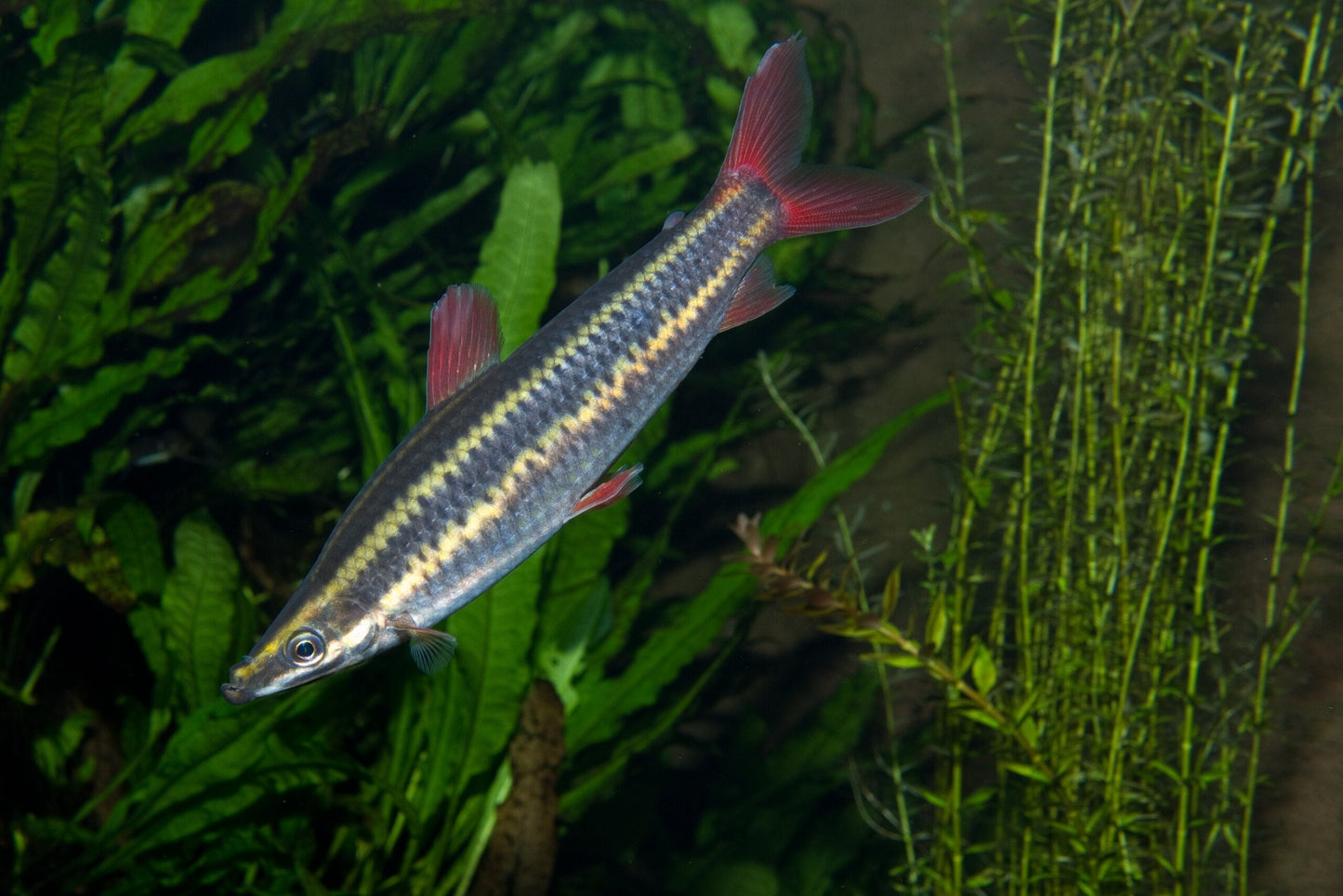
The Striped Headstander has a wide distribution throughout the Amazon and Orinoco River basins, and is known from rocky areas with rapidly flowing waters. Adults congregate in sizeable shoals and may be observed feeding on crustaceans, insects, plant matter, and worms. These fish attain a moderate size and require a spacious aquarium that measures at least 4ft x 18" x 18" (and preferably larger). Juveniles grow very quickly and should be given space from the outset in order to prevent stunting and associated health problems. The aquarium should be mature and aquascaped with a sand or small-grained, smooth gravel substrate, plenty of sturdy pieces of driftwood and an open swimming space along the front of the tank. Plants are not necessary, but will make the aquarium more aesthetically pleasing; however, as these fish will devour plants, it is essential to choose robust species such as Anubias spp. and Java Fern (Microsorum) that can be tied onto the decor. Of greater importance is the use of powerful filtration (ideally provided by external canisters) and a high level of oxygenation, perhaps provided by spray-bar returns situated above the water line and/or additional powerheads. High water quality is essential for this river-dwelling species, so partial water changes should be carried out on a very regular basis in order to keep nitrogenous waste to a minimum. Sturdy, tight fitting coverslides are requisite, as these fish are accomplished jumpers. Although gregarious in the wild, Striped Headstanders can be rather quarrelsome when maintained in small groups in aquaria. For this reason, it is necessary to keep either a single specimen, or a group of at least 8 individuals together (introduced simultaneously), as then any belligerent behaviour will be spread throughout the shoal, and no one fish will bear the continual brunt of any aggression. Tankmates could include medium-large sized peaceful cichlids (particularly rheophilic species), medium-sized characins, talking catfish (doradids) and suckermouth catfish (loricariids). Small fish will be eaten, and long-finned species will be nipped at, so choose tankmates with care. Anostomus anostomus is classified within the Family Anostomidae (headstanders), of which there are currently some 156 described species within 14 genera. Many species from this family swim at an oblique or head-down angle, hence the common family name of headstander.
Feeding
Omnivorous. Offer a variety of dried (flake, green flake, pellets etc) and frozen foods including white mosquito larvae, bloodworm (sparingly), vitamin-enriched brineshrimp, Mysis shrimp etc, plus some greenfoods.
| Known Names | Anostomus salmoneus, Mormyrynchus gronoveii, Salmo anostomus |
| Origin | Brazil, Guyana, Peru, Suriname, and Venezuela. |
| Maximum Size | 16cm |
| Temperature | 22-28°C |
| Water Parameters | pH: 6.0-7.5, dH: up to 15 degrees. |
| Compatibility | Specialist community |
| Lighting | No special requirements |
| Sexual Dimorphism | In mature fish, the females will be slightly larger and fuller bodied. |
| Diet | Flake, granules, pellets, algae wafers and frozen foods |
- Express Delivery
- 12 Months Warranty
- 7 Days Easy Replace

- Shipping And Return
Add details on availability, style, or even provide a review.
Gaming Audio Tech
Precision Sound. Tap to Control.
Stay locked in with crystal-clear audio and responsive touch controls perfect for gaming or calls.
Work Essentials
Power Meets Portability
Get more done with ultra-thin laptops built for speed, multitasking, and all-day battery life.
-
Free Delivery
On Dry Good Orders above £50
-
Full Online Support
7 Days a week
-
Great Online Deals
Price Match on Items
-
Returns Made Simple
7 Days Return Available (Dry Goods)
- Choosing a selection results in a full page refresh.
- Opens in a new window.